
How to Cook Porridge/Congee (Stove-top Method)
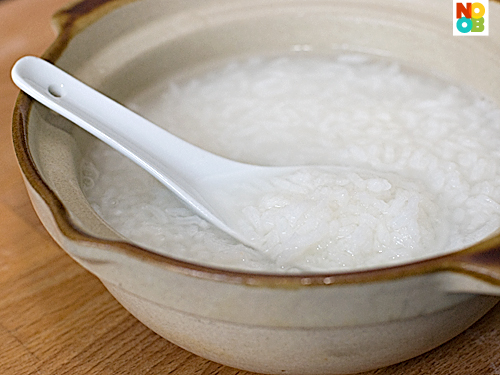
Plain Porridge with simple condiments (ikan bilis powder and fried shallots in shallot oil)
Cooking porridge is one of the easiest things ever. Even easier than cooking rice to me, because there is hardly any risk of using the wrong amount of water – you can easily add more water during cooking if the water dries out, or you if add too much water, the cooked porridge will soak it up after some time (or you can also ladle away a top layer of water). So forgive me for posting such a simple tutorial. But easy as this may be, I was completely clueless when I wanted to cook porridge for the first time. So this little step-by-step pictorial tutorial is for those who have not cooked porridge before :)
Ingredients
- long grain rice
- water
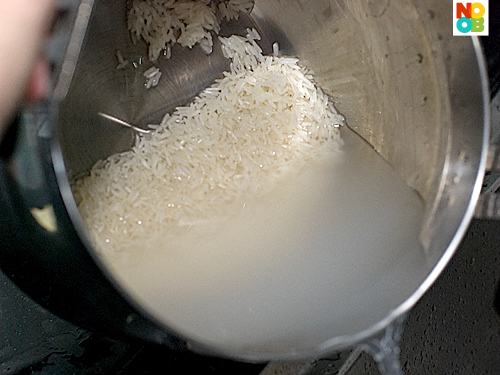
Step 1: Wash rice grains, use your hand to give the water a few swirls and then discard water. You may want to repeat this more than once – some people like to rinse till the water is till completely clear, while others like to rinse till the water is still a bit opaque. Note that the amount of rice used for cooking porridge will be slightly less than the amount for cooking rice, at least for me. For example, I usually cook 1 cup of rice for 2-3 persons, but when I’m cooking porridge, I cook 3/4 cup of rice instead.
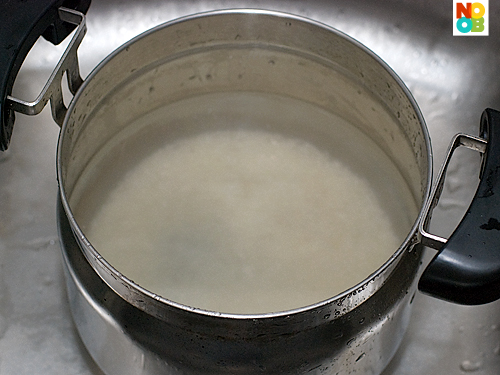
Step 2: Fill pot with water. As you can see from the photo above, I fill the pot till about half full. It is not really necessary to measure the water because it is very forgiving – if you add too much water now, you can use a ladle to scoop the top layer of water away, though the porridge will soak up excess water if you leave it for a while. Anytime the water runs dry (you will hear ‘popping’ sounds, just add hot water to keep the porridge watery and simmering.For those who really need some measurements, for the pot above, I use about 1 and 1/2 cup of rice and I filled the pot with about 2 litres of water.
If you want to be fancy, at this step you can also add ingredients for naturally sweetening the porridge. Ingredients such as soaked dried scallops, soaked soy beans, ikan bilis, red dates etc. I did not add anything extra here because I am making plain porridge.
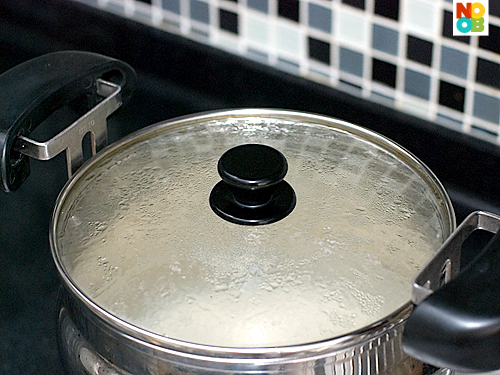
Step 3: Bring the pot to a boil.
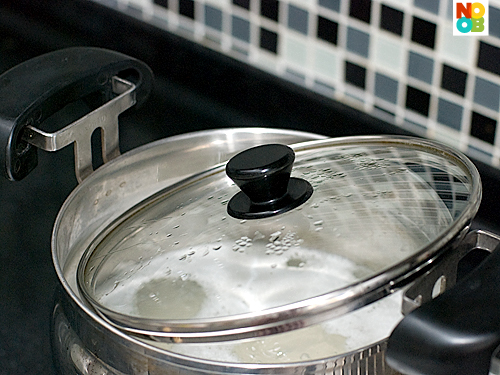
Step 4: Once it comes to a boil, reduce heat to a low simmer. Leave the lid partially opened. This step is VERY important. Otherwise, the water will bubble out of the lid and create a terrible mess and also pose a potential hazard.
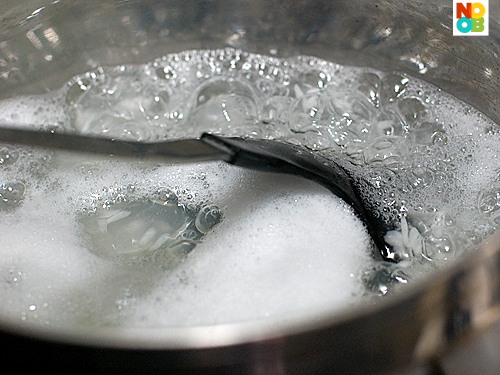
Step 5: Now and then (about every 10 minutes or so), use a soup ladle to gently scrap the bottom of the pan to loosen and dislodge the rice grains that stick to the bottom.
Step 6: Cook the porridge according to the consistency you like. If you still want to see the rice grain (photo above), it usually takes about 20 minutes.
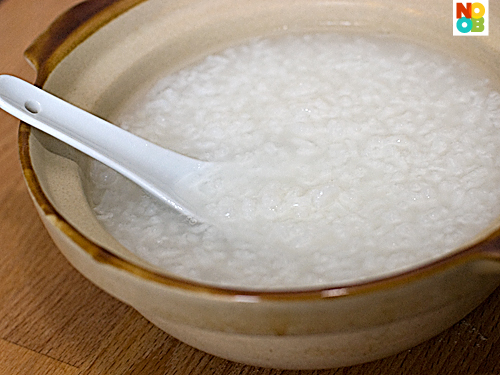
Step 7: Another 10 minutes and the grains separates. This is the consistency I like. You can simmer even longer for a more watery, finer and more congee-like consistency.

Tip: If you leave the pot of porridge for some time, you will realise that the rice grains will soak up all the water. Just add hot water, mix well with a ladle and if you like, bring to a simmer again before serving.
Look out for my upcoming ikan bilis powder and fried shallots recipes, which are excellent condiments to go with porridge.
Love porridge? Check out my porridge recipes.


{ 39 comments… read them below or add one }
Hey it may be a simple tutorial – but an essential one nonetheless! Great photos.
For us who are Asians, making rice porridge is easy as pie :) I have to teach my hubby how to make one.
Anyway, I love using broken rice instead.
broken rice for congee? :)
simple and easy porridge but indeed is a helpful tutorial, I love seeing those pix :)
This tutorial is such a great idea =) I’m sure many of your readers who are noobie cooks appreciate your gentle guidance!
Great tutorial for the newbie!
Usually I cook porridge in rice cooker. I feel that it’s easier. :)
Great tutorial! Although I am too convenience to use my electric porridge cooker now hehehe … :)
woah, electric porridge cooker, sounds like a handy gadget in the kitchen, lucky you :)
Thanks for your guidance which has details even for the simplest recipes – really useful for those who are starting to learn cooking from scratch. For me, I usually ‘pinch’ littles bits of ingredients that will be used to cook for dinner on the same day to add into the porridge. For example, the tail end of a fish with little slivers of meat, and the fish head (that will be discarded anyway for those who do not eat these parts).
that’s a great idea – no waste and added natural flavouring for the plain porridge :)
i so needed this …….. thanks! :)
Great tutorial!
Great pics, clear step by step instructions!
If you want slightly gooey porridge, can consider adding a little glutinous rice.
neat tip, will try it next time when I make congee :)
now i can learn to cook porridge from this post.. haha :D nice post~
I like to cook my congee with chicken stock (normally from 1 whole chicken). I love the addition of 1000 year egg too, but I haven’t got the chance to buy it. Your chicken bowl looks beautifully rustical!
your congee must be full of flavour with the whole chicken stock :)
This is great to see since I’ve never made congee but want to! Can’t wait to see your condiments to go with it.
Congee is one of my favorite comfort foods. I will drag my butt out of bed when I am sick just to make some to slurp down with pickled vegetables (za cai). Love your detailed tutorial. I do have a bad habit of walking away and letting it boil over or get stuck to the bottom O:).
Yes, I agree, porridge is easier to cook than rice!
Hey Noob, great post! I always crave congee whenever I see it on blogs. Can one use whole grain rice though? I’m trying to cut my refined flours/rices and such.
p.s. Your instructional photos are great. I always wish I had someone to help me take those-no such luck though (smile)…
whole grain like brown rice? Yes you can totally do whole that for a healthier version :)
Thanks for your kind words… haha I have no “assistant” for photo taking too. Sometimes I’ll be at a weird angle posing the pot with one hand and holding the camera on the other hand :p
I love love love plain porridge, so good, so so good. Now I only eat such plain porridge when I visit Teochew porridge stalls. I have not bought white (refined) rice for some time already.
u eat brown rice? Ur diet is much healthier than mine, hehe
I love jook too, but haven’t figured out how to make it taste right… Am anxiously waiting for your post on the flavorings!
I have the same thermal pot which I use for soups. Prefer to cook porridge using the rice cooker as I am too lazy to stir constantly and watch the fire. My previous attempts to cook porridge using the pot and stove is disastrous. The rice got stuck to the bottom of the pot and water spilled out. Had a hard time wiping the mess. This tutorial is so useful for beginners as recipe books always assumed that everyone knows the basic. Thanks for the effort.
I have not tried cooking porridge in the rice cooker though my sis does that all the time … I must find out how one day. Yours is the tiger thermal pot right? yes it’s really good for making soups hehe … Thanks for your encouragement :)
I usually make my congee in the rice cooker but it is nice the directions for if I didn’t have a rice cooker! It’s funny on how airlines fix the the porridge soaking up the water. I saw the flight attendant with a metal box of porridge, and then they added boiling water for the coffee/tea to heat the porridge up as well as making it more liquidy.
that’s what I did for too – just pour hot water hehe … So many ppl make the congee in the rice cooker! I really must learn.
Excellent tutorial and an inspirational website for ‘Noobies’.
Would like to know where I can buy the Chicken Bowl ?
Looking forward to your upcoming ikan bilis powder and fried shallots recipes.
chicken bowl for the shallots oil? I bought it at a pasar malam at Kovan. But I think you can find it at neighbourhood shops selling those traditional looking cookware and cutlery or at Chinatown. Thanks for your kind words :)
Nice pics as always!! Congee is one of my fav Chinese comfort foods..:)
awesome post! what a delicious recipe! can I take it tasty! :)
Since I have never cooked porridge this was very useful for me! Thanks for showing us how! I shall make my own now.
In recent months I’ve made a great discovery: my slowcooker makes pretty good congee! Actually I put the rice and water into the pot before I go to bed, turn it on low. and I wake up to the aroma of rice in the morning. It’s very nice!
I think all the commenters have said this already but for what it’s worth – this is a wonderful tutorial on how to make congee. In the Philippines we have a similar dish called Arroz Caldo which is also rice porridge – with your tips I’m going to be adapting my recipe to your soon.
Nice tutorial..We love conjee and this is our Sunday breakfast[Can u belive that!!].We use a mixture of rice like forbidden rice,brown rice,white rice,some lentils like green gram ,black bean,ground nuts,a little snow fungus etc.It s super yum and easily prepared in a pressure cooker:)
Thank you for your guide. Now I know how to make porridge for myself and family already.